January 15, 2026
Enterprise AI Agents (also called agentic AI) are autonomous software systems designed to perform tasks and make decisions on behalf of businesses.
These intelligent agents can handle functions like scheduling, data analysis, or customer interactions, driving efficiency, but also introducing new challenges.
Deploying AI agents at scale raises important questions about development budgets, project timelines (especially around security readiness), system architecture, and selecting the right vendors or service partners. But a fundamental question for business leaders remains:
How much does it cost to build custom AI agents that deliver real enterprise value?
Custom AI agents are not plug-and-play tools. They must integrate deeply with legacy systems, operate securely across sensitive data environments, and comply with governance and regulatory requirements.
As a result, costs vary widely depending on architecture, integration depth, security posture, compliance obligations, and long-term operational needs.
For business leaders, the real challenge is not estimating the cost of “an AI model,” but understanding the total cost of ownership of an AI agent over its lifecycle.
In fact, research shows that integration costs and infrastructure expenses are among the top barriers to accelerating enterprise AI adoption, with nearly half of organisations citing these as key cost concerns.
Let me break down this guide into:
- Realistic cost ranges for enterprise AI agents
- The hidden drivers that inflate budgets
- Security and compliance timelines leaders must plan for
- Architecture decisions that impact long-term ROI
- How to choose the right development and security partners
Whether you are a CEO evaluating strategic investments or a CFO planning multi-year budgets, this article provides a grounded, executive-level view of what it truly takes financially and operationally to deploy AI agents at enterprise scale.
Core Cost Tiers: From Simple to Enterprise-Scale
The development budget for an AI agent depends heavily on complexity, integrations, and compliance requirements.
Simple prototypes or FAQ chatbots can often be built for a few thousand dollars, while mid-scale agent solutions typically run tens of thousands.
In contrast, full enterprise-grade AI agent deployments with multiple agents, custom models, and strict security controls usually exceed $50K.
Enterprise AI projects typically fall into a few cost tiers, from basic prototypes to full production deployments. Below is a summary based on recent industry pricing data from multiple AI development cost guides:
1. Prototype / MVP AI Agent (~$10,000–$50,000)
At the low end, basic AI agents, such as simple FAQ bots, proof-of-concept assistants, or narrow decision-focused agents, can be developed relatively quickly. These solutions often:
- Use pre-trained models or simple rule-based logic
- Require limited integration with backend systems
- Deliver basic task automation without governance
Typical costs for such implementations, according to real pricing guides, range from about $10K to $50K.
Now, take note that this tier is primarily for internal validation or pilot initiatives, not full production.
2. Mid-Scale AI Agent (~$50,000–$250,000)
Once an AI agent needs to integrate with multiple enterprise systems (CRM, ERP, ticketing, etc.), process business data with custom model training, support moderate user volumes, and include basic logging and monitoring, the costs grow accordingly.
So, Mid-tier solutions for commercial use or departmental deployments typically range from $50K to $250K.
This aligns with industry analysis showing that mid-level AI applications often require multiple model components, ETL pipelines, and custom engineering.
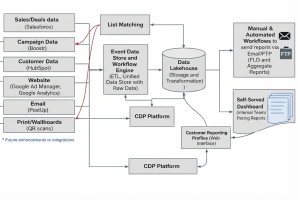
We have delivered a similar solution for one of our enterprise clients, where the requirement was to upgrade the data architecture and introduce automation for reporting and insights delivery.
In that engagement, multiple data sources (sales, campaigns, website activity, email, and offline touchpoints) were unified through an event-driven ETL and lakehouse architecture, enabling automated workflows, dashboards, and self-serve reporting across teams.
The workflow diagram below illustrates a representative mid-scale AI and data architecture, where integration, transformation, and automation drive both operational efficiency and business visibility.
3. Enterprise-Grade AI Agent ($250K+)
This is about building fully productionised AI agents with high-availability requirements. It includes advanced natural language understanding, orchestration across many workflows, and the ability to ensure enterprise security and compliance controls. Fine-tuned or custom models can easily exceed $250,000, with larger organisations spending into the $500K–$2M+ range when scale, governance, and high SLAs are required.
Key cost drivers at this level include:
- Legacy system integration
- Scalable architecture
- Custom model data engineering
- Deep security and compliance requirements
For industries such as finance or healthcare that require strict regulatory adherence (e.g., GDPR, HIPAA), budgets should be expected at the higher end of this spectrum, especially when full audit, governance, and safety measures are included.
What Drives Costs in Enterprise AI Projects
Beyond development, enterprises must budget for related costs: data preparation pipelines, cloud infrastructure, and ongoing maintenance. Here’s what it looks like:
1. Data Engineering and Preparation
Data quality matters. Poor data quality can add 30–50% to project costs due to cleansing, governance, and pipeline development.
2. Model Complexity and Training
Off-the-shelf models reduce upfront expense. Custom model training, multi-modal reasoning, and proprietary fine-tuning significantly increase costs, sometimes more than doubling budgets compared to API-only solutions.
3. Integrations with Legacy Systems
Half of enterprises report integration costs as a top budget item when deploying AI, especially in large organisations with brittle or undocumented APIs.
4. Security & Compliance
Regulation adds cost. Enterprise projects that require compliance with SOC 2, GDPR, HIPAA, or industry-specific standards typically pay significant premiums, often 20–40% above basic implementation costs.
5. Hidden and Operational Costs
Integration surprises, change management, ongoing maintenance, and training often inflate budgets beyond initial quotes. Analysts note that hidden TCO, everything beyond development, can add tens of thousands per year to the total spend.
Realistic Enterprise Budgeting Recommendation
Based on current industry data:
- Pilot / Proof of Concept: Plan for $10K–$50K
- Mid-Tier Deployment: Plan for $50K–$250K
- Large Enterprise Scale: Plan for $250K–$1M+
These ranges include basic development, integrations, and limited operational cost planning, not long-term maintenance or security hardening.
If you are a CEO or a CFO, here are some strategic takeaways for you:
- Don’t treat AI as a one-time cost. Plan for lifecycle spend, including maintenance, retraining, and compliance.
- Allocate 15–25% of initial build costs annually for ongoing operations, security, and updates. Industry benchmarks confirm this recurring spend bracket across enterprise deployments.
- Prioritise integration and data readiness early. These are the biggest foreseeable cost drivers in enterprise environments.
Why Security and Compliance Drive Cost and Timelines?
Building security and compliance into an AI project often parallels the core development timeline. Industry benchmarks suggest that full deployment of an enterprise AI solution typically takes 6–12 months, and securing it can extend that further.
For enterprise leaders, the real inflection point in AI agent investment is not development, it’s security readiness and compliance.
Once an AI agent moves from experimentation into production, it becomes:
- A decision-making system
- A data access point
- A potential attack surface
This is where many AI initiatives slow down or exceed initial budgets. According to enterprise security research, AI-driven systems increase both data exposure risk and operational complexity, particularly when agents operate autonomously across systems and users.
That’s why enterprise AI timelines are best understood as two parallel tracks:
- Build & integration
- Security hardening & compliance
Both must move together. Here is a typical enterprise timeline: Build + Secure
Based on enterprise deployments and our experience delivering AI-enabled platforms, a realistic timeline looks like this:
Phase 1: Architecture & Requirements (6–10 weeks)
- Define the AI agent scope and autonomy level
- Identify data sources and integrations
- Establish security, privacy, and compliance requirements
- Align stakeholders (IT, security, legal, business teams)
At this stage, we at Primotech.ai typically engage at the leadership and strategy level, helping executives define where AI agents should act and where human oversight is required.
Phase 2: Development & Integration (12–20 weeks)
- AI agent development and orchestration
- Integration with CRM, analytics, marketing, or operational systems
- Data pipelines (ETL, event streaming, lakehouse integration)
- Initial logging and observability
This is where our execution experience comes into play. In multiple client engagements, AI initiatives required upgrading data architecture before meaningful automation or intelligence could be deployed, often adding weeks but reducing long-term risk.
Phase 3: Security Hardening & Compliance Readiness (12–24 weeks, overlapping)
Security does not happen after deployment. It must be built in parallel:
- Threat modeling for AI-specific risks (prompt injection, data leakage, model abuse)
- Identity and access controls (RBAC, MFA, tokenization)
- Encryption (at rest and in transit)
- Logging, audit trails, and explainability
- Internal and third-party security testing
For regulated enterprises, this phase often extends timelines significantly. Moreover, formal compliance processes can add months of effort. Let me break it down into details for you.
Security Cost Components Enterprises Must Budget For
Security is not a single line item; it’s a stack of ongoing investments.
1. Governance & AI Risk Management
- AI usage policies and approval workflows
- Human-in-the-loop controls
- Model behavior monitoring and escalation paths
At the strategy level, we at Primotech help leadership teams define AI governance frameworks that align with business risk tolerance, not just technical capability.
2. Technical Security Controls
Enterprise AI agents typically require:
- Secure APIs and gateways
- Network segmentation
- Secrets management
- Content filtering and output validation
In Primotech-led implementations, these controls are often integrated directly into the AI workflow layer rather than bolted on later, reducing rework and audit friction.
3. Compliance & Audit Readiness
Depending on the industry, this may include:
- SOC 2 (Type I / II)
- HIPAA
- GDPR / CPRA
- Industry-specific regulations
Preparing for SOC 2 alone commonly takes 4–6 months, and HIPAA readiness can require six-figure annual audit and compliance costs when external assessors, legal review, and infrastructure changes are included.
4. Penetration Testing & AI-Specific Threat Testing
Traditional pen testing is not enough for AI systems.
Enterprises must test for:
- Prompt injection attacks
- Unauthorized data inference
- Abuse of autonomous actions
- Model manipulation
These assessments are increasingly required by enterprise procurement and security teams before go-live approval.
Ongoing Security & Operational Costs
A common mistake is treating security as a one-time expense. In reality, annual security and operational costs typically run 15–25% of the original development budget, covering:
- Continuous monitoring
- Model retraining and drift detection
- Patch management
- Re-certification and compliance updates
In Primotech-managed Agentic AI solutions, this ongoing layer is often formalized as a managed service, providing predictability for CFOs and continuity for operations teams.
In total, enterprises should plan for about a year to both build and “harden” AI systems. Even after deployment, ongoing investment (security patching, monitoring, and re-validation of controls) accounts for a significant fraction of costs.
Why Architecture and Right Partner Choice Determine Long-Term ROI
By the time enterprises reach Phase 3 of their AI agent journey, the discussion shifts from “Can we build this?” to “Can we scale, secure, and sustain this?”
This phase determines:
- Whether AI agents remain isolated tools or become enterprise platforms
- Whether costs stabilize or compound over time
- Whether leadership retains control over risk, data, and outcomes
Poor architectural decisions or the wrong development partner can lock organizations into inflexible systems, rising cloud costs, or unmanageable security exposure. Strong decisions here, however, compound value year over year.
Enterprise AI Agent Architecture: What “Production-Ready” Really Means
Enterprise AI agents are not single-model applications. They are multi-layered systems designed for resilience, governance, and integration.
A production-ready architecture typically includes:
1. Core Intelligence Layer
- Large language models (LLMs) or custom-trained models
- Planning and reasoning modules
- Task orchestration logic (single agent vs multi-agent workflows)
This is where strategic decisions are made:
- How autonomous should agents be?
- Where should human oversight apply?
- Which decisions should never be automated?
2. Data & Integration Layer
- ETL or event-driven pipelines
- Data lakehouse or warehouse integration
- Real-time and batch data handling
This layer often drives more complexity (and cost) than the AI model itself. AI agents only became viable after modernizing the underlying data architecture and unifying fragmented systems, enabling automation to deliver value.
3. Security, Governance & Observability Layer
- Access controls (RBAC, MFA, token-based access)
- Audit logs and explainability
- Output validation and guardrails
- Continuous monitoring and alerting
For enterprise adoption, this layer is non-negotiable. It is also where many early AI projects fail when security is added too late.
4. User & Interface Layer
- Internal dashboards
- APIs
- Chat, voice, or workflow interfaces
This is where adoption lives or dies. Even the most advanced AI agent fails if teams cannot trust it or interact with it easily.
Deployment Models and Their Cost Implications
How and where AI agents are deployed has a major impact on cost, risk, and scalability.
Cloud-Based Deployment |
On-Premises / Private Cloud |
Hybrid Deployment |
| Best for: Scalability, speed, innovation Trade-offs: Ongoing compute costs, vendor compliance reliance |
Best for: Regulated industries, sensitive data Trade-offs: Higher upfront infrastructure cost |
Best for: Balancing risk and scale |
| Cloud deployment is common for:
– Customer-facing AI agents – High-volume inference workloads |
Enterprises in healthcare, finance, or government often choose this route to retain control over their data. | A hybrid approach is increasingly common:
– Sensitive data stays private – Compute-intensive tasks burst to the cloud
|
| Costs are lower upfront but increase with usage. CFOs should plan for usage-based variability rather than fixed costs. | On-prem or private cloud deployments typically involve higher setup costs but lower long-term compliance risk. | From both a technical and financial standpoint, hybrid models often offer the best long-term flexibility, especially for enterprises expecting AI usage to grow unevenly across departments. |
How Much Do AI Agent Development Services Cost (via Partners)?
When working with external partners, pricing depends on scope and engagement model:
Typical Ranges
- Basic custom AI projects: ~$10K–$50K
- Mid-scale enterprise solutions: ~$50K–$250K
- Large-scale enterprise platforms: $250K–$1M+
Pricing Models
- Fixed-scope project pricing
- Time & materials
- Retainers or managed services
- Hybrid (build + operate)
Offshore or distributed teams can reduce hourly rates, but lower hourly rates do not always translate into lower total costs. Integration failures, security gaps, or rework often erase initial savings.
How to Choose the Right Enterprise AI Agent Development Partner?
Selecting the right AI Agent development partner is critical to project success. Key considerations include:
1. Proven Enterprise Experience
Look beyond demos. Ask questions like:
- Have they delivered AI systems at enterprise scale?
- Can they reference projects involving security, compliance, and integrations?
This is where our execution track record matters; delivery experience across data, automation, and enterprise platforms reduces downstream risk.
2. Architecture-First Thinking
You should avoid partners who start with tools instead of architecture. The right partner designs for scale from day one. It helps you avoid vendor lock-in, and they align AI agents with existing enterprise systems.
3. Security and Compliance Maturity
Your partner should embed security into development workflows, understand AI-specific threats, and be fluent in regulatory requirements. Security cannot be subcontracted as an afterthought.
4. Long-Term Support & Accountability
AI agents evolve. Ensure your partner supports:
- Model updates
- Monitoring and drift management
- Ongoing optimization
In several of our previous engagements, clients shifted from project-based delivery to managed services to stabilize costs and performance over time.
5. ROI and Outcome Clarity
Finally, insist on clarity, ask them real questions like:
- What business metrics will improve?
- What timelines are realistic?
- How is success measured beyond “it works”?
Strong partners tie AI output to operational or financial KPIs, and not just technical performance.
By rigorously evaluating these factors, organizations like yours can partner with an agentic AI development firm like Primotech that not only builds a capable AI agent but also drives tangible business value.
Please take note that enterprise AI agents are not just a technology investment; they are an operating model decision.
If you plan holistically across cost, security, architecture, and partnerships, you turn AI from experimentation into sustained competitive advantage.
For more details or a consultation, please feel free to reach out to us at Contact@Primotech.com