February 23, 2026
Many AI development projects fail because organizations begin implementation without a clear business strategy, reliable data foundations, or the right AI development company to align AI initiatives with measurable outcomes.
Companies often underestimate the complexity of integrating AI into enterprise workflows, leading to fragmented pilots, unrealistic ROI expectations, and stalled deployments.
These AI development company challenges are especially common when businesses choose vendors that focus solely on model building rather than on end-to-end transformation, including data engineering, governance, adoption, and scaling.
An experienced AI and LLM development company helps organizations move beyond experimentation by designing outcome-driven AI roadmaps, selecting high-impact use cases, and ensuring enterprise-ready deployment frameworks.
Without this structured approach, even well-funded initiatives face common AI development project failures, including poor data quality, lack of executive alignment, insufficient change management, and unclear ownership.
Understanding why AI projects fail is the first step for business leaders who want to avoid costly missteps and build scalable, ROI-focused AI systems that deliver long-term competitive advantage.
For CXOs and enterprise leaders, artificial intelligence is no longer an experimental technology. It has become a central pillar of competitive strategy, powering predictive analytics, automation, customer intelligence, and generative AI-driven innovation.
However, despite increasing enterprise spending on AI, a significant number of AI development project failures continue to occur because organizations underestimate the complexity of moving from proof-of-concept models to enterprise-scale production systems.
At Primotech, we work with global enterprises to design AI transformation strategies that address these risks early, ensuring AI initiatives align with business goals, data readiness, infrastructure capabilities, and long-term operational scalability.
What Is an AI Project Failure?
An AI project failure occurs when an initiative fails to deliver a measurable business impact despite the development investment. Failure does not always mean technical
malfunction. It often means:
- The model was never deployed to production
- The deployment did not influence business decisions
- ROI targets were not met
- Adoption across teams stalled
Most enterprise AI failures are operational and strategic in nature.
The Real Scale of AI Project Failures
Despite massive investments in artificial intelligence, many enterprises still struggle to translate experimentation into measurable business value. Multiple global research studies confirm that AI consulting firm challenges are not theoretical; they are statistically significant risks affecting most enterprise initiatives.
A widely cited Cornell University analysis of enterprise machine-learning initiatives found that over 80% of initiatives fail to deliver real business value, primarily due to strategy gaps, weak processes, and lack of organizational support, rather than technical limitations.
Similarly, industry implementation studies indicate that up to 85% of big data and AI-related initiatives fail, often because organizations lack alignment between decision-makers defining the AI vision and technical teams executing it.
Even structured surveys across enterprises reveal that a significant portion of AI R&D initiatives, around one-third, are abandoned or fail, often due to missing strategy frameworks, insufficient data readiness, or inadequate cross-departmental collaboration.
What These Statistics Mean for Business Leaders
For CXOs and founders, these findings highlight a critical insight. AI project failure is rarely caused by poor algorithms. Instead, the most common causes include:
- Lack of clear business objectives tied to measurable ROI
- Poor data strategy and governance
- Weak change-management planning
- Talent shortages or fragmented execution teams
- Treating AI as a technology experiment rather than a business transformation initiative
Organizations that approach AI without a strategic implementation partner often face repeated pilot failures, escalating infrastructure costs, and delayed production deployments, one of the biggest AI development project failure patterns seen globally.
This is why many enterprises increasingly work with experienced AI transformation partners who can align strategy, data readiness, model development, and enterprise deployment from the start.
Top 10 Avoidable Mistakes That Cause AI Development Project Failures
While AI adoption continues to accelerate across industries, most AI development companies face recurring strategic and operational challenges. Business leaders who understand these risks early can significantly improve their probability of success and ensure that AI investments translate into measurable business outcomes.
Below are the most common reasons for AI project failure observed in enterprise AI deployments.
1. Starting Without a Clear Business Problem
Many organizations begin AI initiatives because of competitive pressure rather than a defined business objective. Without measurable KPIs, such as revenue growth, cost reduction, or operational efficiency, projects quickly lose direction and executive support. Successful enterprises begin with business-value-driven use-case identification.
2. Poor Data Readiness and Governance
AI systems are only as effective as the data that powers them. Fragmented datasets, missing governance policies, and inconsistent data pipelines frequently delay or derail deployments.
Companies often underestimate the effort required for data cleaning and labeling, governance and compliance frameworks, real-time data integration, and data security and access management. This is one of the most critical factors in AI development project failures across industries.
3. Treating AI as an IT Project Instead of a Business Transformation
AI initiatives that sit exclusively within IT teams often struggle to scale. AI success requires cross-functional ownership involving operations, product teams, finance, and leadership.
Organizations that embed AI within strategic business transformation programs consistently achieve higher ROI.
4. Lack of Executive Alignment and Sponsorship
When leadership teams are not fully aligned on expected outcomes, budgets, and transformation timelines, AI programs face decision bottlenecks and funding interruptions.
Strong executive sponsorship ensures:
- Clear success metrics
- Organizational adoption
- Faster decision cycles
- Long-term funding continuity
5. Underestimating Change Management Requirements
AI implementation changes workflows, decision processes, and employee responsibilities. Without structured change-management strategies, resistance to adoption significantly slows impact realization.
Successful companies invest in employee training programs, adoption roadmaps, role transition planning, and AI literacy initiatives.
6. Choosing the Wrong Use Cases for Early Deployment
Selecting overly complex enterprise-wide projects for initial implementation often leads to delays and failed pilots. High-impact but manageable use cases should be prioritized first to build organizational confidence.
7. Insufficient MLOps and Deployment Planning
Many AI initiatives stop at model development and never reach production because deployment pipelines, monitoring systems, and lifecycle management processes were not designed early.
Operationalizing AI requires:
- Scalable cloud architecture
- Monitoring and retraining pipelines
- Performance governance frameworks
- Continuous integration and deployment processes
8. Talent Fragmentation Across Vendors and Teams
Working with multiple disconnected vendors, data providers, model developers, and infrastructure partners creates integration challenges and accountability gaps. This is a major AI engineering firm challenge faced by enterprises scaling AI.
A unified AI and LLM development company partner helps streamline execution, ownership, and accountability for delivery.
9. Ignoring Ethical, Compliance, and Governance Considerations
Regulatory requirements related to privacy, explainability, and fairness are becoming increasingly strict across regions. Failing to incorporate responsible AI governance early can halt deployments later.
10. Expecting Immediate ROI Without Iterative Scaling
AI is a capability that compounds over time. Organizations expecting instant enterprise-wide ROI often prematurely label initiatives as failures instead of scaling successful pilots systematically.
Enterprises that avoid these mistakes typically follow a structured AI maturity roadmap, starting with strategy alignment, building strong data foundations, deploying focused pilots, and then scaling across the organization with a long-term transformation vision.
Our enterprise AIML specialists help organizations identify high-ROI use cases, build enterprise data ecosystems, and deploy production-grade AI systems that drive measurable business outcomes.
Learn more about our AI ML services here!
How AI Failures Differ Across Industries
Failure drivers vary by sector:
| Finance: Regulatory compliance and model explainability delays often halt deployment. | Healthcare: Data privacy constraints and integration with legacy systems create bottlenecks. | Retail: Disconnected data systems prevent real-time personalization scaling. | Manufacturing: IoT integration and infrastructure modernization become primary constraints. |
How Leading Enterprises Successfully Deliver AI Projects
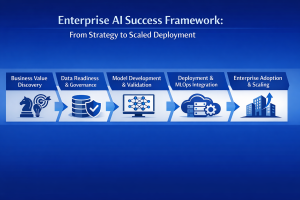
Organizations that consistently succeed in AI adoption follow a structured execution framework that connects business strategy, data readiness, AI model development, and enterprise deployment into one unified transformation roadmap. Instead of treating AI as a series of isolated pilots, leading enterprises design scalable programs that deliver continuous value.
Below is a proven step-by-step framework used by high-performing organizations to avoid AI development project failures and accelerate measurable ROI.
Step 1: Business Value Discovery and Use-Case Prioritization
The first step is to identify high-impact opportunities where AI can deliver measurable business outcomes. Rather than launching multiple experimental initiatives, organizations prioritize 3–5 use cases aligned with revenue growth, operational efficiency, or customer experience improvement.
Key activities include:
- Business stakeholder workshops
- ROI and feasibility assessment
- Competitive benchmarking
- KPI and success-metric definition
This ensures AI investments remain outcome-focused from the start.
Step 2: Enterprise Data Readiness and Governance Foundation
Once use cases are defined, organizations prepare the underlying data ecosystem. This stage includes building unified data pipelines, ensuring compliance with governance requirements, and establishing secure access frameworks.
Core focus areas:
- Data consolidation and cleansing
- Governance, privacy, and compliance policies
- Real-time data ingestion architecture
- Data labeling and annotation pipelines
Strong data readiness significantly reduces long-term challenges for AI consulting firms.
Step 3: Model Development, Experimentation, and Validation
At this stage, the AI and LLM development company collaborates with business stakeholders to develop machine learning, predictive analytics, or generative AI models aligned with the defined business objectives.
Activities include:
- Algorithm selection and experimentation
- Model training and tuning
- Performance validation against KPIs
- Bias and fairness evaluation
The goal is not just model accuracy but measurable business impact.
Step 4: Enterprise Deployment and MLOps Integration
Many organizations fail because models never move into production. Leading enterprises build deployment pipelines early using robust MLOps frameworks that ensure scalability, monitoring, and continuous improvement.
Deployment focus:
- Cloud-native AI architecture
- CI/CD pipelines for models
- Monitoring, retraining, and performance governance
- Integration with enterprise applications
This step transforms AI prototypes into operational business systems.
Step 5: Adoption, Scaling, and Continuous Optimization
The final step focuses on enterprise adoption and scaling successful AI solutions across departments, business units, and geographies. Continuous monitoring and retraining ensure models evolve alongside business needs.
Organizations typically:
- Conduct employee adoption programs
- Expand successful use cases across business units
- Establish AI Centers of Excellence (CoE)
- Continuously track ROI and performance metrics
Why End-to-End Ownership Reduces Failure Risk
Organizations that centralize accountability across strategy, data architecture, model development, deployment, and governance consistently report higher AI maturity levels.
End-to-end ownership reduces fragmentation, vendor coordination overhead, integration delays, and compliance risk. Vendors that operate across the full AI lifecycle tend to deliver more predictable enterprise outcomes.
Why Partnering with the Right AI Development Company Determines Success or Failure
AI success depends less on model sophistication and more on execution maturity. Many enterprise AI failures originate from fragmented execution. Organizations often work with separate strategy consultants, data engineers, model developers, and infrastructure teams, with no unified accountability.
This creates misaligned KPIs, deployment delays, integration gaps, and governance blind spots. Successful enterprise AI programs require integrated ownership across strategy, data engineering, model lifecycle management, and business adoption.
A qualified enterprise AI partner brings a multidisciplinary approach that connects business consulting, AI engineering, domain expertise, and long-term optimization capabilities.
This integrated delivery model significantly improves the probability of project success, particularly for enterprises implementing mission-critical AI systems.
Key Capabilities That Distinguish High-Impact AI Development Partners
1. Strategy-to-Execution Expertise
The right partner helps define transformation roadmaps, identify priority initiatives, and align AI investments with long-term organizational goals rather than short-term experimentation.
2. Enterprise Data Engineering Strength
Robust AI systems require advanced data pipeline architecture, integration frameworks, and governance mechanisms. Companies with strong data engineering capabilities enable faster, more reliable deployments.
3. Scalable Deployment and Lifecycle Management
Production-ready AI requires lifecycle monitoring, retraining mechanisms, and performance governance frameworks. Experienced vendors design systems that evolve alongside business needs.
4. Cross-Industry Domain Experience
Industry-specific understanding improves use-case design, regulatory compliance alignment, and faster time-to-value across sectors such as finance, healthcare, retail, and manufacturing.
5. Long-Term Optimization and Support
AI is an evolving capability rather than a one-time implementation. Continuous performance optimization, model tuning, and scaling support are essential for sustained ROI.
At Primotech, our enterprise teams work closely with leadership stakeholders to design scalable AI roadmaps, deploy production-grade models, and continuously optimize performance to ensure long-term business impact.
The Future of AI Development: What Successful Organizations Will Do Differently
As AI adoption matures, the gap between organizations that successfully scale AI and those that struggle with repeated AI development project failures will widen significantly.
The next phase of enterprise AI will not be defined by who experiments first, but by who builds structured, scalable, and continuously improving AI capabilities across the organization.
1. From Isolated AI Projects to Enterprise AI Platforms
Instead of launching disconnected pilots, leading companies are building centralized AI platforms that support multiple use cases across departments. This platform-based approach enables faster experimentation, standardized governance, and reduced development costs over time.
2. Rise of LLM and Agentic AI Implementation at Scale
Large Language Models (LLMs) and autonomous AI agents are rapidly becoming operational tools across customer service, internal productivity, analytics, and decision support, making specialized enterprise AI expertise increasingly critical for enterprises seeking a competitive advantage.
3. AI Governance and Responsible AI Becoming Core Business Requirements
Regulatory pressure and enterprise risk management requirements are pushing organizations to embed governance, transparency, and monitoring frameworks directly into their AI lifecycle processes. AI initiatives without these structures will struggle to move beyond experimentation.
4. Continuous AI Optimization Replacing One-Time Implementations
AI systems are evolving into continuously improving assets rather than static deployments. Organizations that invest in lifecycle monitoring, retraining pipelines, and performance optimization will extract significantly greater long-term value from their AI investments.
Businesses that learn early from common causes of AI project failure and invest in scalable AI operating models today will lead their industries over the next decade.
Building these capabilities requires not only advanced engineering expertise but also strategic transformation guidance, areas where experienced enterprise AI partners become long-term innovation allies rather than a short-term vendor.
Turning AI Ambition into Measurable Business Outcomes
As competition accelerates across every sector, organizations that proactively avoid the leading causes of AI project failure will deploy solutions faster, achieve higher ROI, and create a sustainable competitive advantage.
Working with a specialized AI development company enables enterprises to move from experimentation to enterprise-grade deployment with lower risk, faster implementation timelines, and measurable long-term value.
Ready to avoid costly AI development project failures and build scalable enterprise AI systems?
Work with our AI & LLM development company to design, develop, and scale production-ready AI solutions aligned with your strategic business goals. Contact us for more details today!
Frequently Asked Questions (FAQs)
1. Why do many AI development projects fail?
Most AI initiatives fail due to unclear business objectives, insufficient data readiness, lack of integration planning, and absence of lifecycle governance. Organizations that approach AI as a technology experiment rather than a business transformation program often struggle to achieve measurable ROI.
2. What are the biggest challenges faced by an enterprise AI implementation partner during enterprise deployments?
Common challenges in enterprise AI implementation include fragmented data environments, complex legacy system integrations, evolving regulatory requirements, and the need to operationalize models through scalable MLOps pipelines while maintaining performance and governance standards.
3. How can enterprises reduce the risk of AI development project failures?
Enterprises can reduce failure risk by starting with clearly defined business use cases, conducting AI readiness assessments, building strong data engineering pipelines, implementing governance frameworks early, and partnering with an experienced Enterprise AI implementation partner that provides end-to-end lifecycle support.
4. What role does an AI consulting firm play in scaling enterprise AI?
A specialized AI implementation team provides strategic consulting, architecture design, model development, deployment automation, performance monitoring, and continuous optimization—ensuring AI systems evolve into scalable enterprise assets rather than isolated pilot projects.
5. When should a company partner with an external AI development company?
Organizations should partner early—during the strategy and feasibility stage—so that data readiness, infrastructure design, integration architecture, and governance frameworks are planned correctly from the beginning, significantly increasing the success rate of enterprise AI initiatives.