March 23, 2026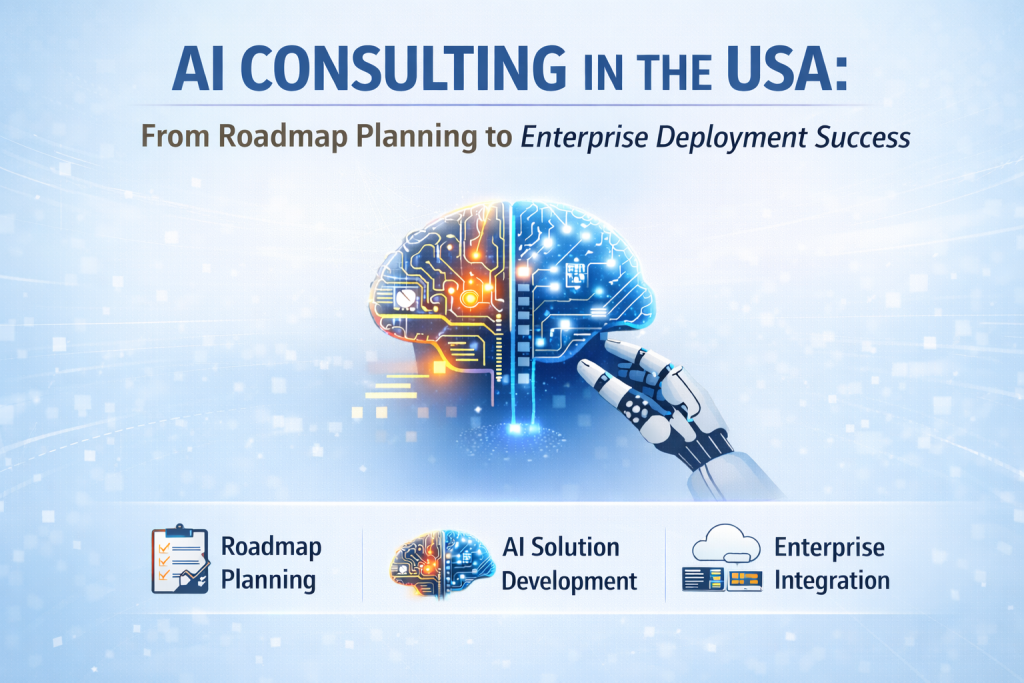
AI consulting in USA is now about building a scalable, enterprise-wide AI operating model. The organizations that succeed are aligning AI initiatives with core business objectives, modernizing their data infrastructure, implementing governance frameworks, and deploying production-ready systems that deliver measurable outcomes.
AI consulting today spans the full lifecycle, from strategic roadmap planning and use case prioritization to data engineering, model development, system integration, compliance oversight, and long-term optimization.
The companies that win in this environment share three common traits:
A clearly defined AI strategy aligned with revenue and operational KPIs
Clean, structured, and accessible enterprise data infrastructure
A consulting partner capable of translating technical execution into business impact
In the United States, where competition and regulatory scrutiny are both high, successful AI adoption requires more than technology expertise.
It requires disciplined execution, cross-functional alignment, and enterprise-grade deployment capabilities that turn AI ambition into scalable operational success.
According to an SNS Insider report in Yahoo Finance, the U.S. AI consulting services market was valued at $2.42 billion in 2024 and is projected to reach $13.28 billion by 2032. That is 23.73% CAGR.
That growth is driven by urgency. Boards have mandated AI. Budgets have been allocated. But 42% of companies scrapped most of their AI initiatives in 2025, up sharply from just 17% the year before.
An MIT report states that 95% of enterprise gen-AI pilots fail to deliver measurable P&L impact, mostly due to integration, data, and governance gaps.
This article explains exactly what separates the 5% that succeed from the 95% that don’t, and what enterprise AI consulting in the USA must deliver to move your organization from roadmap to real ROI.
Why Most AI Strategies Fail Before They Start
Most organizations entering AI consulting conversations make the same mistake: they lead with the technology question: “Which model should we use?”
When the real question is: “What operating problem are we solving, and do we have the data infrastructure to solve it?”
The uncomfortable truth is that most organizations treat AI as a technology problem when it’s actually an operating model challenge. You’re actually redesigning how decisions get made and how value gets created.
The Real Barriers to Enterprise AI Deployment
The failure stack is well-documented. Informatica’s 2025 CDO Insights survey identifies the top obstacles to AI success as data quality and readiness (43%), lack of technical maturity (43%), and skills shortage (35%).
Notice what’s missing from that list: model capability. The models work. The surrounding infrastructure doesn’t.
Here are the 4failure modes that dominate failed enterprise AI deployments:
No business case anchored to revenue or cost: Initiatives that start as technology experiments without a clear tie to P&L are the first to be cut when budgets tighten. AI must have an executive-backed business case before a single line of code is written.
Fragmented data architecture: The technology isn’t the constraint. The data infrastructure is. Zillow lost over $500 million, not because its AI algorithm was flawed, but because the model was trained on incomplete data that couldn’t account for real-world market dynamics. The same pattern repeats across enterprise deployments in every sector.
Siloed teams: When business units, IT, and data science operate independently, even technically successful pilots fail to reach production. Shared ownership across functions is not optional — it is the mechanism of deployment.
Pilot paralysis: Organizations launch proof-of-concepts in safe sandboxes but fail to design a clear path to production. Integration challenges such as secure authentication, compliance processes, and end-user training are often overlooked until leadership asks for a production launch timeline.
Understanding these failure modes is the starting point for any credible AI consulting engagement. A consulting partner who doesn’t address all four is just giving you a slide deck.
What a Real AI Roadmap Looks Like
An AI roadmap is a sequenced business transformation plan with clear milestones, defined accountability, and measurable outcomes at every stage.
Stage 1: Business Understanding Before Technology Selection
The first conversation in any AI consulting engagement should not involve models, vendors, or platforms. It should involve your business’s most expensive unsolved problems.
- Where are decisions delayed because data isn’t synthesized fast enough?
- Where is manual work consuming skilled labor that could be redirected?
- Where do you lose revenue because you can’t personalize at scale?
Great AI consulting firms like Primotech use structured discovery frameworks to convert those business pain points into AI opportunity maps, ranked by potential ROI, data availability, and implementation complexity.
This triage is what separates high-impact AI from “AI theater.”
Stage 2: AI Readiness Assessment
Before any use case moves to design, an honest readiness assessment must evaluate three dimensions:
Data maturity: Do you have the right data, in the right format, accessible to the right systems? Winning programs earmark 50–70% of the timeline and budget for data readiness: extraction, normalization, governance metadata, quality dashboards, and retention controls. Most organizations dramatically underinvest here.
Infrastructure readiness: Can your current cloud, on-premise, or hybrid environment support model training, inference, and monitoring at the scale required?
This includes latency requirements, security boundaries, and integration points with existing ERP, CRM, and operational systems.
Talent and organizational readiness: Do you have the internal capability to sustain AI post-deployment?
This is about whether your operations team can interpret model outputs, whether compliance understands governance requirements, and whether leadership is prepared to make operating model changes when AI recommendations conflict with legacy processes.
Stage 3: Use Case Prioritization and Business Impact Analysis
Not all AI use cases are equal. The most common mistake U.S. enterprises make is investing in the most visible use cases, customer-facing chatbots, and sales copilots, while ignoring back-office automation that delivers faster payback periods.
Over 50% of GenAI budgets flow to sales and marketing despite back-office automation (document processing, compliance, internal workflows) consistently delivering higher ROI
Effective AI consulting firms apply a use-case scoring framework that weighs business impact (revenue, cost, risk), data availability and quality, technical complexity, time-to-value, and regulatory exposure.
The output is a prioritized roadmap including a sequenced deployment plan with defined timelines and success criteria for each initiative.
Stage 4: AI Governance, Ethics, and Compliance Planning
This is the stage most competitors skip or address too late, and it is precisely where enterprise AI deployments go wrong in regulated industries.
For U.S. enterprises operating in healthcare, finance, insurance, and government contracting, AI governance is not a nice-to-have. It is a compliance and legal requirement.
A credible enterprise AI consulting company must help clients build governance frameworks covering: model explainability and auditability; data lineage and provenance; bias detection and mitigation; role-based access control for model outputs, and regulatory alignment with HIPAA, GDPR, CCPA, and sector-specific frameworks.
In the USA, the regulatory environment is moving fast. Governance frameworks built now protect you from compliance exposure later.
Stage 5: Infrastructure and Talent Planning
Infrastructure decisions made in year one shape scalability for the next five.
The cloud vs on-premise vs hybrid decision reflects your data residency requirements, latency tolerances, and total cost of ownership calculations over a multi-year horizon.
Alongside infrastructure, talent planning must address the full AI workforce lifecycle: who builds and trains models, who monitors and retrains them, who governs outputs, and how you upskill existing employees to work effectively alongside AI.
Stage 6: Proof of Concept and Pilot Program Design
The PoC stage is where strategy meets reality, and where most organizations lose momentum. The key is to design pilots that are production-ready from day one, not sandbox experiments that will require complete reconstruction for enterprise deployment.
Effective PoC design means: targeting one specific, high-value workflow; ensuring data completeness for that workflow is verified before model development begins; defining success metrics in business terms (cost reduced, decisions accelerated, revenue influenced); and building integration with existing systems as part of the pilot, not as a subsequent phase.
External vendor partnerships achieve 66% deployment success compared to just 33% for internally built tools. This is not an argument against building internal capability.
Enterprise AI Deployment: From Pilot to Production at Scale
Getting to production is where the real consulting challenge begins. Recent statistics suggest that 88% of AI pilots never make it to production, meaning only about 1 in 8 prototypes becomes an operational capability.
The path from a validated PoC to a scaled enterprise deployment requires deliberate change management, integration architecture, and continuous monitoring, none of which are purely technical problems.
The Four Patterns That Separate Successful Deployments
- Start with unambiguous business pain: Successful programs draft AI specifications only after stakeholders can articulate the cost of not solving the problem with AI. The non-AI alternative cost is the baseline against which ROI is measured.
- Invest disproportionately in data pipelines: Not in models. Data pipelines. The architecture that feeds clean, current, contextual data into your AI systems is the determinant of model accuracy in production. Most failed deployments traced their failure to data infrastructure decisions made in the first 90 days.
- Choreograph human-AI collaboration, not replacement: Applying AI to customer care and operations functions can increase productivity at a value ranging from 30 to 45% of current function costs, as per McKinsey’s The Economic Potential of Generative AI report. Durable enterprise deployments define the division of labor between humans and machines at the design stage, not as an afterthought when adoption fails.
- Operate AI as a living product: AI systems degrade without active management. Model performance drifts as real-world conditions change. Successful enterprise AI programs maintain on-call rotation schedules, versioning roadmaps, retraining pipelines, and outcome metrics tied to real business dollars.
What Enterprise-Scale AI Deployment Costs in the USA
Pricing transparency is something most competitors avoid. Here’s the market reality for U.S. enterprises:
Small AI pilot projects typically range from $5,000 to $50,000, covering initial strategy consulting, proof-of-concept development, and readiness assessment.
Mid-sized AI implementations, covering a single department or workflow with moderate integration complexity, typically fall between $100,000 and $500,000.
Enterprise-level AI deployment, encompassing multiple integrated systems, governance frameworks, change management, and ongoing optimization, ranges from $500,000 to several million dollars, depending on data complexity, regulatory requirements, and the scope of operating model change required.
The ROI Reality of Enterprise AI Deployment in the USA
Finance and Banking: The leading sector for AI consulting adoption, capturing 19% of market share, as per a report by SNS Insider via Yahoo Finance. Use cases with validated ROI include fraud detection at transaction speed, credit risk modeling, regulatory compliance automation, and personalized wealth management. The regulatory complexity of the sector makes governance-first AI consulting non-negotiable.
Healthcare: AI in clinical decision support, medical coding automation, prior authorization processing, and patient engagement has demonstrated measurable cost reduction. HIPAA compliance and explainability requirements demand consulting partners with specific healthcare AI governance experience.
Manufacturing and Logistics: Predictive maintenance, supply chain optimization, and quality inspection AI are mature, high-ROI use cases. Integration with legacy OT systems and ERP platforms is typically the primary technical challenge.
Retail and E-Commerce: Demand forecasting, dynamic pricing, and personalization engines have demonstrated both revenue lift and margin improvement. Data infrastructure to support real-time inventory and customer behavioral data is the common readiness gap.
Professional Services and Legal: Document intelligence, contract analysis, and knowledge management AI are early-stage but rapidly maturing. Risk around model hallucination in legal contexts demands robust human-in-the-loop workflow design.
How to Select the Right AI Consulting Partner in the USA
The AI consulting market in the USA ranges from global management consultancies (McKinsey, BCG, Deloitte, PwC) to specialist AI boutiques to mid-market technology service providers. Each has distinct advantages and limitations.
Large management consultancies offer deep industry expertise and change management capability, but often deliver strategy without sustained implementation ownership.
Pure-play AI boutiques deliver technical depth but may lack the cross-functional business transformation perspective.
Mid-market, well-specialized AI consulting firms like Primotech often deliver the most practical combination: business-grounded strategy, technical execution, and the proximity to your team that enterprise-scale firms cannot provide.
Here is the evaluation framework that experienced CTOs and CIOs actually use when selecting an AI consulting partner:
Production track record, not demo sophistication: Ask every candidate firm: show me a deployment that has been live for at least six months, serving real users at scale, with documented performance metrics. A polished slide deck is not evidence of delivery capability.
Industry-specific compliance experience: A consultant who overlooks one sector-specific regulation can stall or kill a deployment. Verify that the firm has direct experience with the regulatory frameworks governing your industry before engaging.
Data infrastructure capability: The bottleneck in enterprise AI is not model selection; it is data architecture. Assess whether the firm’s team includes data engineers with enterprise integration experience, not just data scientists.
Governance and ethics framework maturity: Ask to see the firm’s AI governance methodology. Can they demonstrate how they implement model explainability, bias monitoring, and compliance documentation? Generic answers reveal generic capabilities.
Change management approach: AI deployment failure is often cultural, not technical. Ask how the firm handles employee adoption, leadership alignment, and operating model change. Firms without a change management practice will leave you with a great model and an organization that doesn’t use it.
Pricing structure and outcome alignment: Beware of consulting engagements priced purely on time and materials with no linkage to business outcomes. The best AI consulting firms in the USA are willing to define success metrics upfront and price accordingly.
Why a Mid-Sized AI Consulting and Development Partner Is the Ideal Choice for U.S. Businesses Outsourcing AI Development
More than 90% of employees already use personal AI tools such as ChatGPT at work, yet only around 40% of companies provide official enterprise-grade LLM access. This gap is not just a statistic. It reveals that AI adoption is already happening at the employee level, often without governance, security controls, or strategic oversight.
A capable AI consulting partner does not fight this behavior. Instead, they identify internal power users during the discovery phase and design enterprise AI deployments that align with existing workflows. Adoption accelerates when strategy meets real-world usage patterns rather than forcing artificial change management.
Large Enterprises Are Slower, and It’s Getting Worse
Large enterprises run the most pilots but take nine months on average to scale, compared to just 90 days for mid-market firms. If you run a large enterprise, your AI consulting partner’s change management and stakeholder alignment capability is as important as their technical methodology. Speed of scaling is a competitive advantage, and it is largely determined by organizational readiness.
The Center of Excellence Model Is the Scalability Answer
Organizations that successfully scale AI beyond isolated use cases consistently establish an AI Center of Excellence (CoE), an internal hub that owns governance standards, vendor relationships, reusable components, and knowledge transfer across business units.
A strong enterprise AI consulting company like Primotech helps you build the internal capability to sustain, adapt, and expand them. Without this, you remain permanently dependent on external consultants for every subsequent initiative.
The Primotech Approach: Enterprise AI Consulting Built for U.S. Business Leaders
Primotech’s AI consulting framework is built around the reality that enterprise AI success is an execution problem, not a technology problem.
From AI readiness assessment through governance framework design, use case prioritization, infrastructure planning, PoC development, and scaled deployment, every phase is grounded in business outcomes, not technology novelty.
With proven delivery across finance, logistics, and enterprise operations, Primotech brings both the technical depth to integrate AI with existing ERP, CRM, and cloud infrastructure and the strategic clarity to keep leadership aligned throughout the transformation journey.
For U.S. founders and business leaders, this means a consulting partnership that doesn’t hand you a roadmap and exit. It means an end-to-end engagement that gets you from AI strategy to production deployment to a sustainable internal capability, positioned for the competitive advantage AI actually delivers when it’s implemented right.
The Decision Framework for AI Consulting in the USA
Before you engage any AI consulting firm, use this five-point decision framework:
Define your business problem first. The consulting firm that helps you do this before recommending technology is the one worth hiring.
Assess your data infrastructure honestly. If your data is fragmented, unclean, or inaccessible, your AI investment will fail. Address this in scope.
Demand governance from day one. Not as a compliance checkbox, but as the framework that makes AI trustworthy enough for your teams to actually use.
Production plan, not just pilots. Design every PoC with the production integration architecture already defined.
Build internal capability, not permanent dependency. The right consulting partner makes themselves progressively less necessary, not more.
AI consulting in the USA in 2026 is about selecting a partner who understands your business model deeply enough to translate AI potential into competitive advantage and execute with discipline.
Before allocating budget to another pilot, evaluate your organization against real deployment criteria rather than experimentation metrics.
Our AI consulting team provides a structured readiness assessment tailored specifically to U.S. enterprise requirements, helping leadership teams move from AI ambition to measurable operational impact.
FAQs
1. What does AI consulting in the USA typically include?
AI consulting in the USA typically includes AI strategy development, readiness assessment, data infrastructure planning, use case prioritization, model development, governance framework design, proof-of-concept implementation, and enterprise-scale deployment. Leading firms also provide post-deployment monitoring, retraining pipelines, and internal capability building.
2. Why do most enterprise AI projects fail?
Most enterprise AI projects fail due to data quality issues, fragmented infrastructure, lack of governance, unclear business cases, and poor integration planning. The failure is rarely due to model capability. It is usually caused by operational and organizational gaps.
3. How much does enterprise AI consulting cost in the USA?
AI consulting costs vary based on scope. Small pilots range from $10,000 to $50,000. Department-level implementations typically range from $100,000 to $500,000. Full enterprise-scale AI deployments can range from $500,000 to several million dollars, depending on complexity, regulatory requirements, and integration depth.
4. How long does enterprise AI deployment take?
A properly structured AI roadmap and deployment typically takes 3 to 12 months, depending on scope. Large enterprises may require additional time due to governance, integration complexity, and change management requirements.
5. How do I choose the right AI consulting partner in the USA?
When selecting an AI consulting partner, evaluate their production deployment track record, industry compliance expertise, data engineering capability, governance frameworks, change management methodology, and willingness to align pricing with business outcomes. Avoid firms that focus only on strategy or only on model experimentation without end-to-end deployment ownership.