March 17, 2026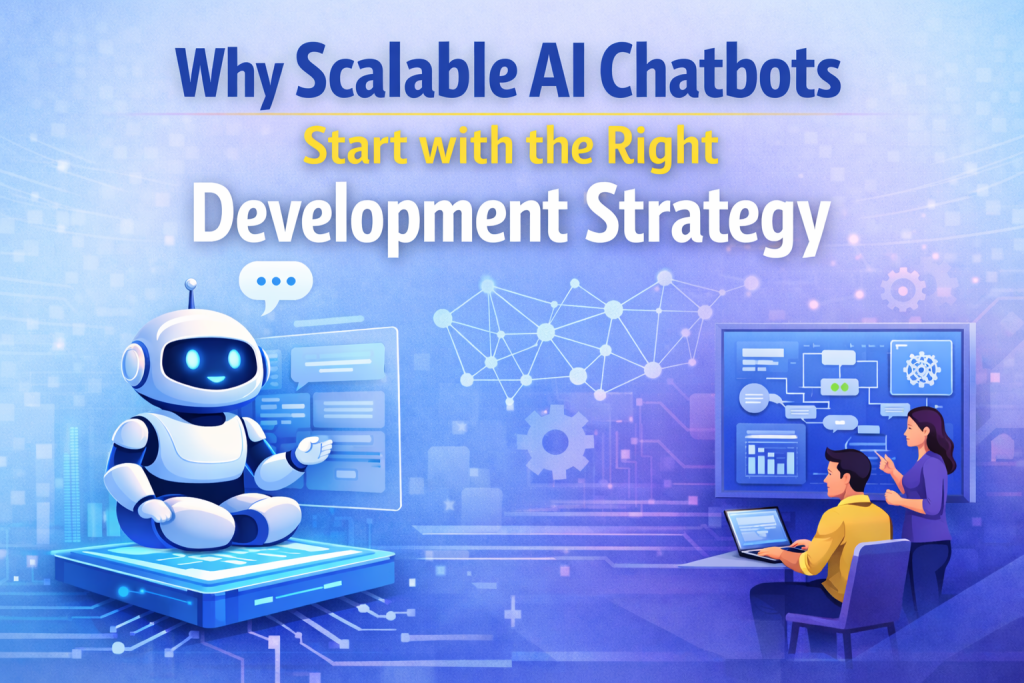
Scalable AI chatbots start with the right development strategy because long-term performance, reliability, and cost efficiency are determined by foundational architectural decisions made before development begins.
What this means for building scalable AI chatbot development strategy in 2026 is to have a comprehensive strategy grounded in architectural decisions made before the first line of code is written, including conversational state management, multimodal integration, enterprise system connectivity, and production-grade observability.
Without this strategic foundation, even technically advanced chatbot models struggle to scale reliably, leading to performance bottlenecks, inconsistent responses, and rising operational costs.
The AI chatbot market is projected to reach $29.5 billion by 2029, growing at 23.3% annually through 2030, indicating that organizations succeeding in this space are those deploying with architectural clarity.
At Primotech, we have built enterprise AI chatbot solutions across healthcare, fintech, SaaS, and e-commerce, and the pattern is consistent: the difference between a chatbot that scales and one that collapses under production load is the strategy baked into its foundation from day one.
The Chatbot Market in 2026: What Changed and Why Strategy Matters Now
The conversational AI market has matured past the early experimentation phase.
In 2025, we crossed an inflection point where 25% of organizations now use chatbots as their primary customer service channel, and over 987 million people globally interact with AI chatbots regularly. This is now about infrastructure.
What sets 2026 apart from prior years is the shift from rules-based chatbot architectures to LLM-powered-architectures.
GPT-4o, Claude Sonnet 4.5, Gemini 2.0, and DeepSeek R1 are just better at natural language understanding.
They are fundamentally different systems that require different development strategies.
These models handle context retention, ambiguity resolution, and multi-turn reasoning in ways that were not possible with intent-classification systems built on older NLP frameworks.
According to Grand View Research, the global chatbot market was valued at $7.76 billion in 2024 and is projected to reach $27.29 billion by 2030, with North America holding 31.1% market share driven by enterprise adoption in customer service, sales automation, and internal operations.
Healthcare chatbot adoption alone is growing at 24.97% CAGR, while retail and e-commerce maintain a 27.95% market share.
The Chatbot Taxonomy in 2026: Understanding What You Are Actually Building
One of the first strategic errors organizations make is conflating chatbot types. The term AI chatbot obscures critical architectural differences.
Here is the taxonomy that matters in 2026:
1. Rules-Based Chatbots (Legacy, Still Deployed at Scale)
These systems operate on decision trees and keyword matching. They work well for highly constrained, predictable interactions such as password resets, order tracking, and FAQ responses.
They are fast, cheap, and interpretable, which is why they still dominate in scenarios where compliance and auditability matter more than conversational flexibility.
Banks and regulated industries still deploy rules-based bots for tier-1 support queries, where deviations from the script create legal risk.
2. Retrieval-Based Chatbots (RAG-Powered, Context-Aware)
These systems use Retrieval-Augmented Generation (RAG) to ground LLM responses in verified knowledge bases. The chatbot retrieves relevant documents, passages, or structured data at inference time and injects that context into the LLM prompt.
This architecture is the workhorse of enterprise AI chatbot solutions in 2026, combining the conversational fluency of LLMs with the factual reliability of curated data.
Primotech has deployed RAG-based chatbots for healthcare clients where hallucination risk is intolerable. The bot can answer patient questions about treatment protocols while grounding every response in FDA-approved documentation.
3. Generative Chatbots (LLM-Native, Open-Domain)
These are pure LLM systems, GPT-4o, Claude, and Gemini that can be deployed without retrieval layers. They excel in creative tasks, open-ended conversation, and scenarios where the goal is engagement rather than precision.
Consumer-facing chatbots in entertainment, education, and content creation often use this architecture. The trade-off is between the risk of hallucination and the inability to cite sources, making them inappropriate for high-stakes enterprise use cases without additional guardrails.
4. Agentic Chatbots (Tool-Calling, Multi-Step Workflows)
This is the frontier. Agentic chatbots that act. They call APIs, query databases, trigger workflows, and orchestrate multi-step processes autonomously.
An agentic chatbot in a SaaS product might not only answer ‘What is my account balance?’ but also execute ‘Transfer $500 to savings and send me a receipt via email.’
These systems use function-calling capabilities in GPT-4o, Claude, and Gemini 2.0 to interact with external tools. AppVerticals reports that agentic chatbots deliver 3× higher conversion rates and 35% higher average order value, but they also introduce significant complexity in error handling, state management, and security.
5. Multimodal Chatbots (Voice + Video + Text)
Multimodal chatbots process and generate across text, voice, and video modalities. The healthcare use case we are building, an AI chatbot with audio and video avatar capabilities that qualifies leads, captures intent, stores interaction data, and routes warm leads to SDRs, represents the next generation of scalable AI chatbot development.
Platforms like HeyGen, D-ID, and Tavus enable video avatar rendering and human-sounding voice synthesis. The chatbot presents itself visually, adapts tone based on user sentiment, and creates a presence that traditional text-based bots cannot match.
The Development Strategy Framework
The failure mode we see repeatedly is organizations that jump into implementation without resolving foundational strategy questions.
Here is the framework Primotech uses to ensure the AI chatbot development strategy aligns with business requirements from the start.
1. Define the Conversational Scope and Failure Boundaries
What is the chatbot allowed to do? What happens when it encounters a query outside its scope? These are strategic constraints that we focus on first.
An airline customer service bot cannot say ‘I don’t know’ when asked about flight cancellation policies. It must have a deterministic fallback: escalate to a human agent, retrieve from a knowledge base, or redirect to a self-service portal.
The strategy decision is: where does the bot’s authority end, and how does it hand off gracefully?
2. Choose the LLM Stack Based on Latency, Cost, and Control Requirements
Not every chatbot needs GPT-4o. For high-volume, low-complexity interactions, Gemini 2.0 Flash or Claude Haiku 4.5 delivers sub-second response times at a fraction of the cost.
For reasoning-intensive workflows such as fraud detection, multi-step diagnostics, and complex scheduling, GPT-5 or DeepSeek R1 justifies the latency premium.
For regulated industries where data residency is non-negotiable, self-hosted LLaMA 4 or Mistral models deployed on-premises provide full control.
The strategy question is: what is the acceptable trade-off between intelligence, speed, and cost?
3. Design for Conversational State Management from Day One
LLMs are stateless. Every API call is independent. If your chatbot needs to remember that the user already provided their email address in a previous exchange, you are responsible for maintaining that state.
At scale, state management is the difference between a chatbot that feels intelligent and one that frustrates users by repeatedly asking the same questions.
Primotech uses Redis or DynamoDB for session state persistence, with TTLs that match the expected conversation duration.
The strategy decision is: how long does the bot need to remember, and what happens when memory expires?
4. Plan for Multimodal Integration Early (Even If You Ship Text-Only First)
According to a Gartner report, 40% of generative AI solutions will be multimodal by 2027, and users increasingly expect chatbots to support voice input and avatar-based responses.
The strategic mistake is building a text-only architecture that cannot accommodate multimodal capabilities without a full rewrite.
Even if your MVP is text-based, the system architecture should anticipate voice transcription (Whisper, Deepgram), voice synthesis (Tavus, Google TTS), and video avatar rendering (HeyGen, D-ID).
The strategy question is: will this architecture support multimodal expansion without requiring a ground-up rebuild?
5. Embed Observability and Eval Loops Before Launch
You cannot improve what you do not measure. Production chatbots generate thousands of interactions daily, and without structured observability that includes conversation logs, sentiment analysis, escalation rates, and response latency, you are effectively operating without visibility.
More critically, you need evaluation loops that continuously assess response quality against ground truth.
Primotech instruments chatbots with LangSmith, Weights & Biases, or custom eval pipelines that flag hallucinations, measure retrieval accuracy, and identify conversational dead ends.
The strategy question is: how will we know if this chatbot is getting better or worse over time?
How Primotech Builds Scalable AI Chatbots: Our Development Methodology
At Primotech, we do not treat AI chatbot development as a feature sprint. We treat it as an infrastructure build.
Here is the phased approach that has allowed us to ship production-grade chatbots for healthcare, fintech, and enterprise SaaS clients.
Phase 1: Requirements Mapping and Use Case Definition
We begin by mapping every intended interaction to a use-case taxonomy: informational query, transactional request, diagnostic workflow, or escalation trigger. Each use case gets a success criterion and a failure mode. This phase typically takes 1–2 weeks and produces a decision matrix that guides all downstream development.
Phase 2: Architecture Design and LLM Selection
We select the LLM stack based on the use case matrix. For the healthcare chatbot, we are using Claude Sonnet 4.5 for reasoning and GPT-4o for multimodal processing, with a RAG layer powered by Pinecone for medical knowledge retrieval.
The architecture includes Redis for session state, PostgreSQL for interaction logs, and a custom eval framework that scores every response against HIPAA-compliant ground truth.
We also define fallback strategies: if the primary LLM times out, the system falls back to a cached response or escalates to a human agent. This phase takes 2–3 weeks and produces a system design document that becomes the contract between product and engineering.
Phase 3: Iterative Development with Continuous Evaluation
We build conversational modules for symptom intake, insurance verification, and appointment scheduling, and evaluate each module independently before integration.
Each module ships with a test suite that includes adversarial prompts (jailbreak attempts and nonsensical input), edge cases (users switching topics mid-conversation), and performance benchmarks (response latency under load).
This phase is where most traditional chatbot projects fail, because they defer eval until the end. We evaluate continuously, which means we catch architectural flaws early when they are cheap to fix.
Phase 4: Multimodal Integration and Avatar Deployment
An AI avatar we built adapts facial expressions and tone based on sentiment analysis of user input. This level of responsiveness requires real-time audio processing, low-latency video rendering, and careful UX design to avoid the uncanny valley effect.
This phase takes 3–4 weeks and involves significant A/B testing to ensure the avatar feels helpful rather than creepy.
Phase 5: Production Deployment and Continuous Improvement
We deploy behind feature flags with a staged rollout: 5% of traffic, then 25%, then 100%.
At each stage, we monitor escalation rates, user satisfaction scores, and task completion rates.
The first two weeks post-launch are critical because that is when edge cases surface. We maintain a daily sync with the client to triage issues and push hotfixes.
After stabilization, we shift to a continuous improvement cadence: weekly eval runs, monthly model retraining, quarterly architecture reviews.
The Implementation Challenges That Kill Chatbot Projects
Having built dozens of enterprise AI chatbot solutions, we have repeatedly observed the same failure modes. Here are the challenges that derail projects and how to mitigate them.
1. Underestimating Integration Complexity
Every enterprise chatbot needs to integrate with existing systems, including CRM, ERP, billing, scheduling, and knowledge bases.
47% of firms build generative AI in-house specifically to control data pipelines, reflecting how painful integration can be. Primotech front-loads integration planning. We map every API dependency, document authentication flows, and build mock endpoints before writing chatbot logic. This reduces integration surprises from weeks to days.
2. Hallucination Risk in High-Stakes Domains
LLMs hallucinate. In healthcare, finance, and legal domains, hallucination is a liability. The mitigation strategy is RAG with a confidence threshold.
Every LLM response is paired with a confidence score. If confidence drops below a threshold (typically 0.85), the chatbot declines to respond and escalates to a human.
We also implement fact-checking layers: critical claims are cross-referenced against verified knowledge bases before being surfaced to the user.
3. Conversational Dead Ends and User Frustration
Users abandon chatbots when they hit conversational dead ends — ‘I don’t understand your question’ repeated three times is a failure. The fix is an explicit fallback design.
If the chatbot does not understand, it offers structured options: ‘I didn’t catch that. Are you asking about (A) appointment scheduling, (B) insurance, or (C) something else?’ This keeps the conversation moving without forcing the user to rephrase endlessly.
4. Latency at Scale
At Primotech, we aggressively optimize: we cache frequently used queries, use streaming responses (so users see text appear in real time), and deploy edge inference for latency-sensitive use cases. We also use parallel processing. While the LLM generates a response, we pre-fetch likely follow-up retrievals. This cuts perceived latency by 30–40%.
5. Compliance and Data Governance
Regulated industries have strict data handling requirements. HIPAA in healthcare, GDPR in Europe, PCI-DSS in payments. Annual compliance outlays near €29,277 per AI system, making governance a first-order concern.
Primotech designs chatbots with data minimization principles. We log only what is necessary, encrypt data at rest and in transit, and implement role-based access controls.
We also maintain audit trails: every chatbot interaction is logged with user consent, and logs are immutable.
The LLM Stack in 2026: Which Models Power Production Chatbots
The LLM powered chatbot development process in 2026 has fragmented in ways that benefit developers. Here is the stack Primotech uses across different use cases.
For Conversational Fluency: GPT-4o and Claude Sonnet 4.5
These are the gold standards for natural, multi-turn conversation. GPT-4o handles multimodal inputs (text, image, audio) with 320ms voice response latency, making it ideal for real-time voice chatbots.
Claude Sonnet 4.5 excels at instruction-following and long-context retention, which is critical for enterprise workflows where the chatbot needs to remember details across a 20-minute conversation.
For Speed and Cost Efficiency: Gemini 2.0 Flash and Claude Haiku 4.5
When latency matters more than reasoning depth, these models deliver. Gemini 2.0 Flash processes queries in sub-second timeframes, making it perfect for high-volume customer service bots.
Claude Haiku 4.5 is 50% cheaper than Sonnet while maintaining strong performance on straightforward queries.
For Reasoning and Multi-Step Logic: DeepSeek R1 and GPT-5
These models handle complex, multi-step reasoning tasks. DeepSeek R1 introduces fine-grained sparse attention that improves computational efficiency by 50%, which matters when your chatbot needs to process long diagnostic workflows.
GPT-5 scores perfectly on the AIME 2025 math benchmarks and excels at abstract reasoning that simpler models cannot match. We use these for fraud detection chatbots, medical triage systems, and financial advisory bots.
For On-Premises Deployment: LLaMA 4 and Mistral Large 3
When data residency or regulatory requirements prohibit cloud-based LLMs, open-weight models are the answer.
LLaMA 4 runs on-premises with strong performance at 70B parameters, and Mistral Large 3 delivers 92% of GPT-5 performance at 15% of the cost.
AI Chatbot Strategy for Startups vs. Enterprise: What Changes
The AI chatbot development strategy for a 10-person startup is fundamentally different from the strategy for a 10,000-person enterprise. Here is how the approach changes.
For Startups: Speed, Iteration, and Minimal Infrastructure
Startups cannot afford multi-month architecture discussions. The strategy is: ship fast, learn fast, iterate fast.
Use hosted LLMs (OpenAI, Anthropic) via API to avoid infrastructure overhead. Use off-the-shelf tools (Voiceflow, Botpress, Rasa) to accelerate development.
Deploy behind feature flags to iterate without breaking production. Focus on one use case and nail it before expanding.
For Enterprises: Governance, Integration, and Compliance
Enterprises have different constraints. They need data governance frameworks, compliance audits, multi-stakeholder alignment, and integration with legacy systems. The strategy is: plan thoroughly, build incrementally, govern rigorously.
Enterprises typically require on-premises or hybrid deployments, which means self-hosted LLMs or private cloud instances. They need role-based access controls, audit logs, and disaster recovery plans.
So, Strategy First, Technology Second!
Organizations succeeding with scalable AI chatbot development in 2026 are those that treat chatbot development as a strategic investment rather than a feature sprint.
They make architectural decisions before writing code. They instrument observability from day one. They plan for multimodal expansion even when shipping text-only MVPs. They embed evaluation loops into every development cycle.
At Primotech, we have built chatbots across healthcare, fintech, e-commerce, and enterprise SaaS, and the pattern is consistent: the chatbots that scale are those built with strategy baked in from the start. The market data we shared above supports this.
If you are evaluating AI chatbot development companies or planning your own internal build, the framework we have outlined here, use case definition, LLM stack selection, state management, multimodal planning, and continuous evaluation, provides the strategic foundation.
The technology will continue to evolve. Models will become faster and more cost-effective.
But the strategic questions, like: What is this chatbot for? How will it scale? What happens when it fails? They remain constant. If you get those questions right, the rest is execution.
FAQs
1. Why is the development strategy more important than choosing a chatbot model?
The underlying architecture determines scalability, latency, integration capability, and long-term operational cost. Even the most advanced LLM cannot compensate for poor conversational state design, weak observability, or missing integration planning. Organizations that define architecture, data pipelines, fallback logic, and evaluation loops before development consistently achieve more stable production deployments.
2. What is the most scalable chatbot architecture in 2026?
Retrieval-Augmented Generation (RAG) combined with tool-calling agent capabilities, is currently the most scalable enterprise architecture. This approach grounds responses in verified knowledge sources while enabling the chatbot to perform actions such as API calls, workflow automation, and database updates, ensuring both reliability and operational functionality at scale.
3. How long does it typically take to deploy an enterprise-grade AI chatbot?
A production-ready chatbot typically requires 8–16 weeks, depending on integration complexity, compliance requirements, and multimodal capabilities. Projects that skip architecture planning may launch faster initially, but often require major rebuilds later when scaling challenges emerge.
4. What are the biggest risks when scaling AI chatbot systems?
Common risks include hallucinations in high-stakes workflows, integration failures with enterprise systems, poor state management that disrupts multi-turn conversations, and insufficient observability that prevents performance optimization. These risks are minimized when evaluation pipelines, monitoring dashboards, and fallback mechanisms are built into the system from the beginning.
5. How can organizations ensure their chatbot remains scalable as usage grows?
Scalability requires modular architecture, load-tested infrastructure, model routing based on query complexity, and continuous evaluation loops. Partnering with experienced consulting teams such as Primotech helps organizations design chatbot systems that incorporate future growth, multimodal expansion, and enterprise integrations from the outset.