October 27, 2025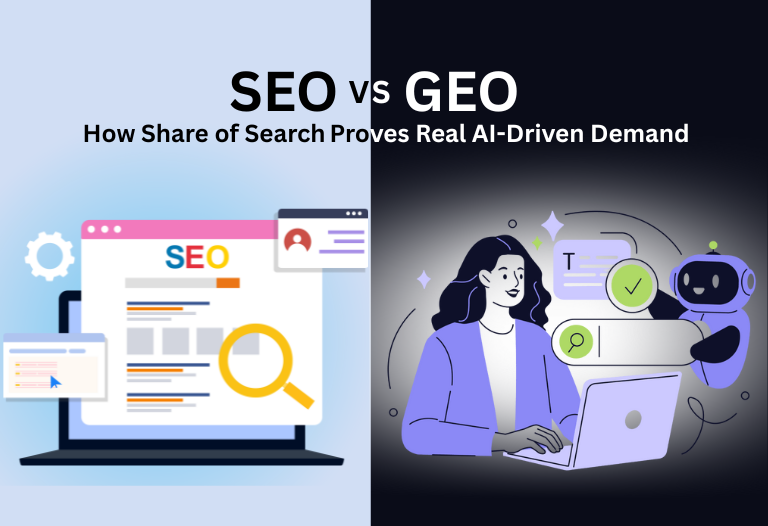
GEO performance is proven through evidence. Share of search, buyer intent, and prompt visibility reveal whether you are generating actual demand.
Before the buzz turns “GEO” into another vague acronym, let’s set the record straight.
Generative engine optimization is not SEO with a makeover.
It is a different discipline.
At its base, GEO is brand marketing delivered through generative interfaces. Treat it like a technical setting, and you will get shallow results.
You will hear noise and see little growth. This is the moment for CMOs to lead. It’s time to conduct an audit and assess the effectiveness of your GEO efforts.
The Guiding Metric: Share of Search
The main measure for GEO should match any brand-led growth effort: share of search.
Share of search signals future market share because it tracks relative demand. It shows your brand against competitors.
If your share grows, someone else’s shrinks, and momentum shifts in your favor.
If your share drops, you give up future revenue. That is the plain reality.
It is not flawless. Yet in category after category, the share of search predicts brand outcomes far better than award decks.
GEO influences this, often through publishing on media platforms
When a language model mentions your brand, users may still open a new tab and search for you.
A recommendation triggers curiosity → Curiosity drives searches → Searches send the signal.
You can expect branded queries to increase as generative tools spread. And people do verify what they see in AI results, so even if your clicks are now fewer, you are getting qualified clicks.
Your first check:
- Compare your brand’s share of search to key competitors.
- Use Google Trends or My Telescope to track branded demand.
- Cross-check with Semrush.
- Focus on the direction, not the weekly bumps.
Do not mix up share of search with share of voice. They serve different roles and come from different thinking.
Two sides of the signal: Brand demand and buyer intent
Share of search splits into two functional layers for GEO:
Brand search: The clearest sign of salience. Are more people searching for you compared to last quarter within your category? That is how you know your availability is rising inside generative engines and in culture.
Buyer-intent traffic: The revenue side. Of your non-branded clicks, how many signal commercial intent rather than basic information? Compare your share of that traffic to competitors.
You will not know the exact click-through rates for others. You do not need them.
- Use Semrush to estimate non-branded commercial demand by topic.
- Compare proportions: you versus them.
- Cross-check with Google Search Console.
- Export, segment, slice by intent.
- Where Semrush estimates diverge from your GSC reality, you uncover signal vs noise.
When third-party estimates differ from your actuals, you learn about data noise and your real market shape.
If brand search remains flat but buyer-intent share increases, you are capturing demand without generating enough of it.
If brand search climbs but buyer-intent share does not, the issue is likely related to conversion or content.
Which means your GEO is generating interest, but your assets are failing to capitalize on it.
- If both rise, you need to scale your efforts.
- If both fall, stop tweaking prompts and fix positioning, advertising, and PR.
And if you’re serious about auditing your AI strategy or building GEO into your growth engine, feel free to reach out to me at Sanjay.bhattacharya@primotech.com